You have lost a tooth, or you are about to, and a dentist has offered you two options: a bridge or an implant. Both restore the gap. Both can look fantastic. But underneath the surface — both literally and clinically — they are very different solutions.
What a bridge actually does
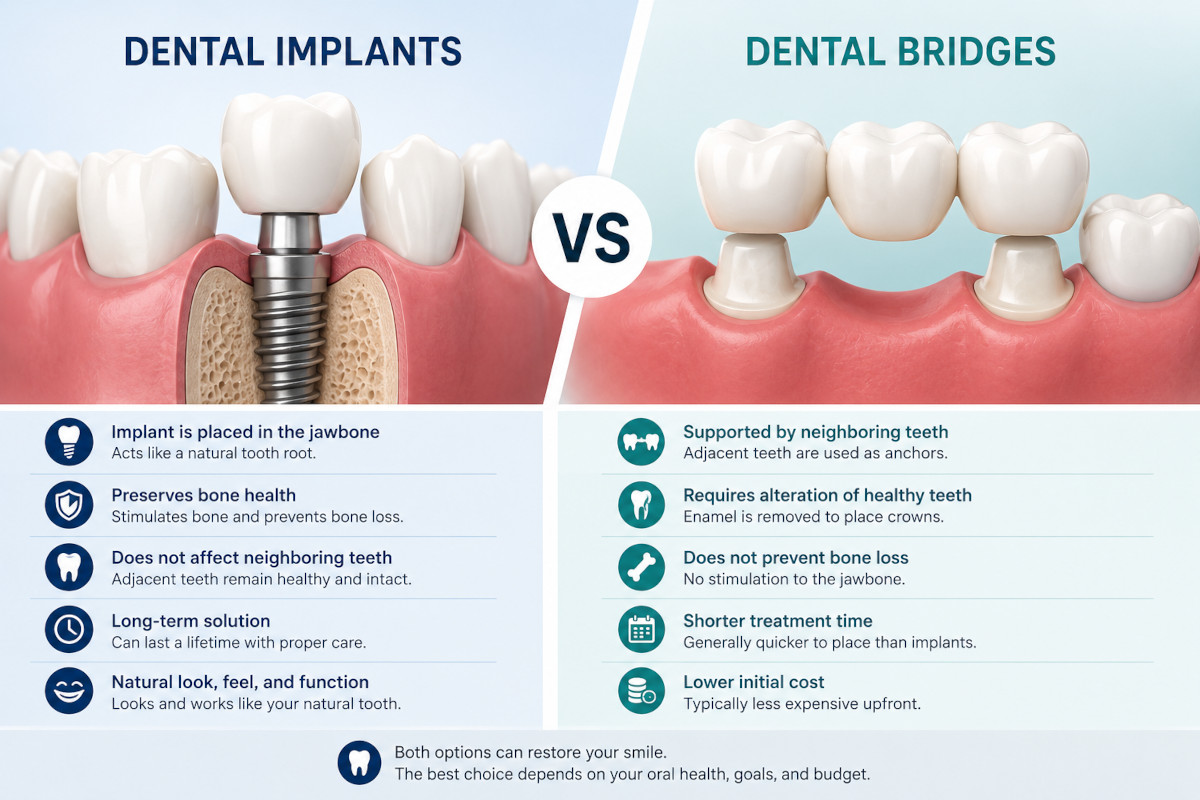
A traditional bridge replaces a missing tooth by anchoring a false tooth (a “pontic”) onto the two teeth on either side of the gap. To do that, the dentist has to grind those neighbouring teeth down to fit crowns over them.
That is the trade-off most patients underestimate: to replace one missing tooth, you damage two healthy ones. If those neighbouring teeth ever need treatment in the future, the whole bridge has to come off.
What an implant does
A dental implant replaces the missing tooth on its own, by placing a small titanium screw into the jawbone where the original root used to be. After healing, a custom crown is attached on top. The neighbouring teeth are left completely untouched.
Side-by-side: the honest comparison
Longevity
- Bridge: typically 10–15 years before replacement is needed.
- Implant: 25 years to lifetime, with proper hygiene.
Impact on neighbouring teeth
- Bridge: requires significant grinding of two healthy teeth.
- Implant: no impact at all on neighbouring teeth.
Bone health
- Bridge: bone underneath the missing tooth continues to shrink over time.
- Implant: stimulates the jawbone like a natural root, preserving facial structure.
Hygiene & feel
- Bridge: needs special floss threaders to clean underneath.
- Implant: cleaned exactly like a natural tooth.
Up-front cost
- Bridge: lower up-front cost.
- Implant: higher up-front cost — but lasts longer and avoids damaging healthy teeth.
Most modern dental schools now teach implants as the default choice for a single missing tooth, with bridges reserved for cases where an implant isn’t possible.
So which one is right for you?
If you have healthy neighbouring teeth, an implant almost always makes more clinical sense. If those neighbouring teeth already need crowns for other reasons, a bridge can be a sensible way to handle two problems at once.
The right answer is rarely obvious until a clinician has seen your scans. If you would like an honest opinion — including which option is genuinely better in your case — send us your X-rays and we will reply with a written plan.